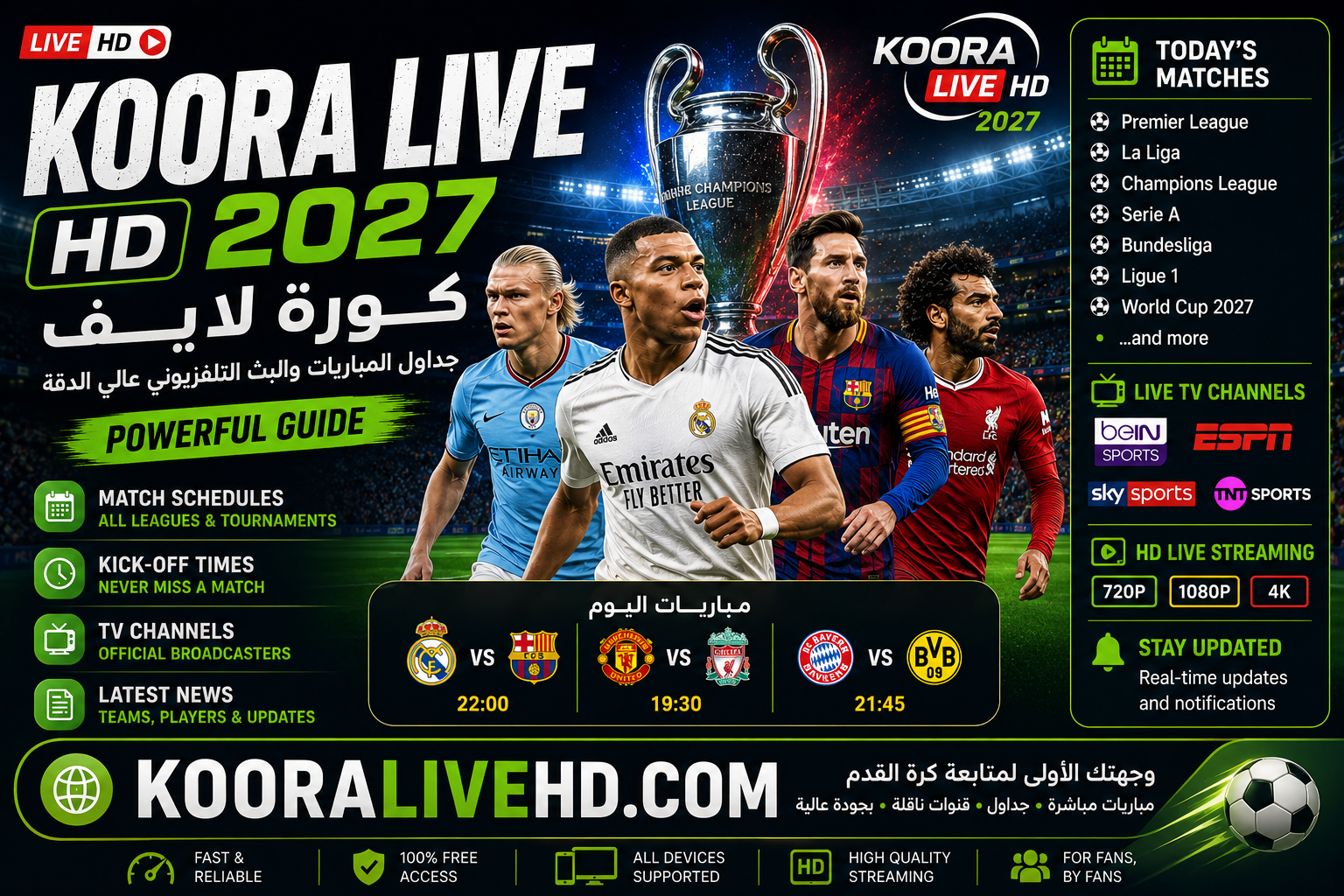
Koora Live Streaming Champions League كورة لايف بث مباشر دوري أبطال أوروبا 2026
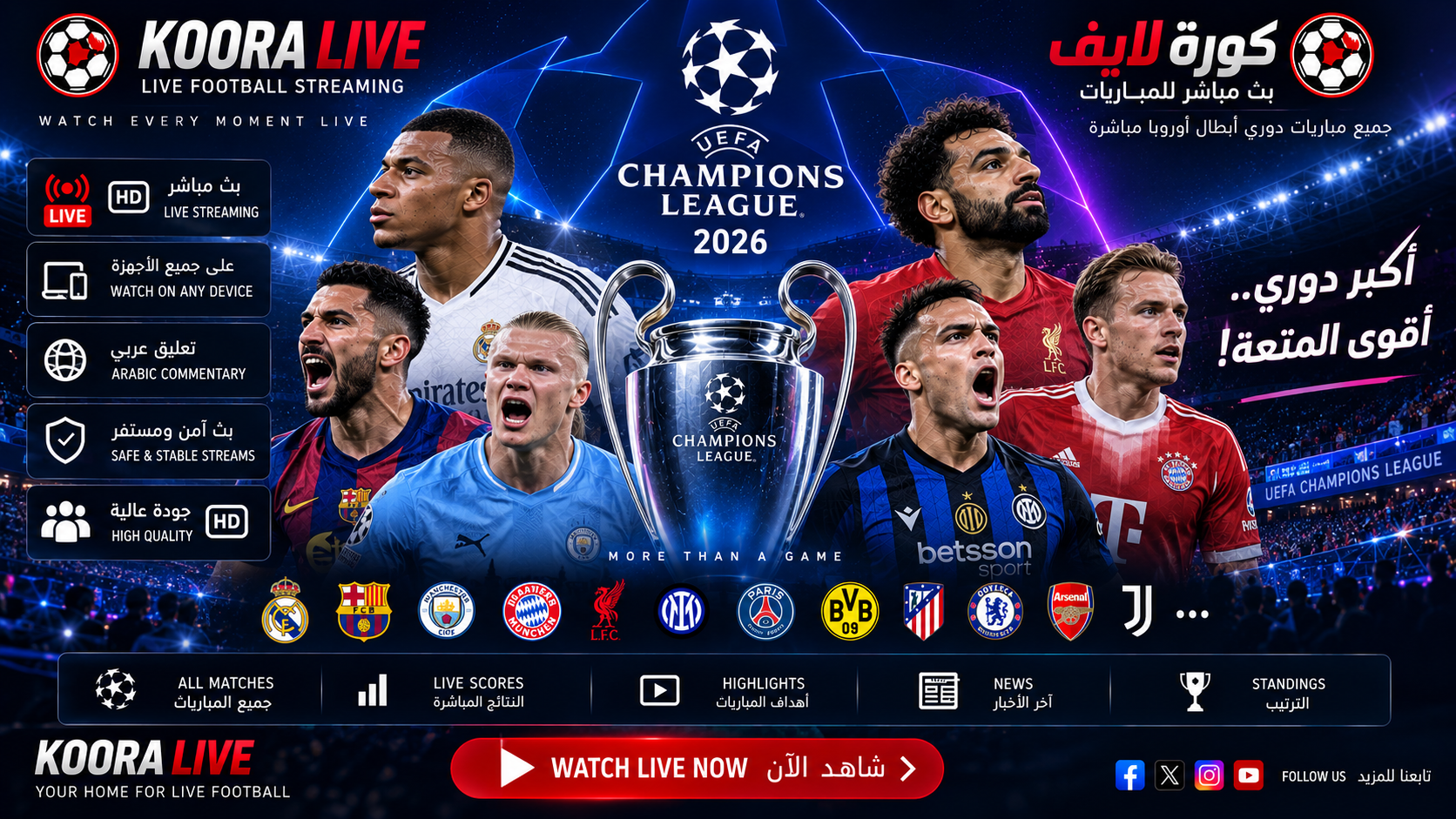
Koora Live Streaming Champions League | كورة لايف بث مباشر دوري أبطال أوروبا 2026 | Powerful Guide
Article Insight: Welcome to the definitive, exhaustively researched cornerstone guide to following, analyzing, and experiencing the 2026 UEFA Champions League season on Koora Live.
This master informational dossier explores the complete technical, tactical, structural, and broadcasting ecosystem of the world’s most prestigious club football competition.
European club football is traversing an extraordinary tactical revolution throughout this fiercely competitive 2026 calendar year.
The continental game has reached unprecedented athletic heights, demanding relentless physical endurance, sophisticated spatial structures, and rapid transitions from every club on the continent.
From the historic cauldrons of Madrid, Milan, and Munich to the modern arenas of London, Paris, and Manchester, the Champions League captures the imagination of billions.
The innovative single-table Swiss model format has completely redefined continental football, eliminating dead rubbers and intensifying drama from the first matchday.
Every single fixture carries massive implications for knockout qualification, coefficient points, and historical prestige.
Supporters across the Middle East, North Africa, Europe, the Americas, and Asia require a reliable, authoritative source to navigate this complex sporting spectacle.
Koora Live delivers this exhaustive informational blueprint to provide verified kickoff timetables, official broadcasting networks, and deep tactical breakdowns.
Whether examining micro-pressing traps or analyzing rest-defense principles, this master guide serves as your definitive companion for the entire 2026 Champions League campaign.
- 1. The Unmatched Prestige: The 2026 UEFA Champions League Phenomenon
- 2. Understanding the 36-Team Single League Phase in 2026
- 3. Tactical Evolution: How Modern Continental Systems Have Transformed the Game
- 4. Global Broadcasting: Official Channels and Licensed Streaming Partners
- 5. High-Performance Streaming Infrastructure: 4K UHD, Frame Rates, and Low Latency
- 6. The Strategic Battleground: Positional Dominance in Modern European Midfields
- 7. Defensive Rest Structures: Counter-Pressing and Transition Prevention
- 8. Elite Contenders and Dark Horses: Assessing the 2026 Title Challengers
- 9. Iconic European Cathedrals: Stadium Acoustics and Matchday Pressures
- 10. International Timings: Worldwide Kick-off Conversion Schedule
- 11. Officiating Standards, Semi-Automated Offside Technology, and VAR Protocol
- 12. Discover More Coverage on the Koora Live Network
1. The Unmatched Prestige: The 2026 UEFA Champions League Phenomenon
The UEFA Champions League stands entirely unmatched as the ultimate pinnacle of global club sports excellence.
Since its inception in 1955 as the European Champion Clubs’ Cup, this tournament has consistently defined the emotional and technical standards of association football.
Every single season brings together the finest athletes, the most visionary managers, and the most passionate supporter cultures on planet earth.
In 2026, the tournament represents a multibillion-euro sporting spectacle that commands the undivided attention of hundreds of millions of global viewers.
Lifting the iconic trophy, affectionately known as “Ol’ Big Ears,” represents the crowning achievement of any player’s professional career.
The unique mystique of midweek European fixtures under floodlights creates an electric atmosphere that domestic leagues simply cannot replicate.
From the haunting strains of the Champions League anthem to the dramatic final-minute turnarounds, the competition produces immortal sporting moments.
Historic dynasties have been forged on this grand stage, cementing the legacies of clubs that dare to achieve continental immortality.
For modern football enthusiasts, following the tournament requires comprehensive, deep, and continuous analytical coverage.
Koora Live has established itself as the trusted digital destination for supporters seeking profound insights into every European matchday.
This tournament is far more than a sporting contest; it is a global celebration of tactical innovation and athletic dedication.
2. Understanding the 36-Team Single League Phase in 2026
The 2026 UEFA Champions League operates under the revolutionary 36-team single-league phase format, transforming competitive dynamics across Europe.
Departing permanently from the traditional four-team group stage, the current structure places all thirty-six competing clubs into one comprehensive league table.
Each participating club contests eight distinct matches during the league phase, facing eight completely different opponents across four home and four away fixtures.
Opponents are meticulously determined through a four-pot seeding system designed to ensure every team faces balanced, high-caliber competition.
Each club plays two opponents from Pot 1, two from Pot 2, two from Pot 3, and two from Pot 4, creating blockbuster fixtures from week one.
The top eight finishers in the 36-team league table secure direct qualification to the prestigious Round of 16 as seeded contenders.
Clubs finishing between 9th and 24th enter a two-legged knockout playoff round, battling intensely to claim the remaining eight spots.
Meanwhile, teams finishing in 25th position or lower are eliminated entirely from European competition, with no safety net drop into the Europa League.
This ruthless elimination framework means that every single goal scored or conceded carries monumental mathematical weight throughout the entire league phase.
Goal difference and goals scored serve as vital tiebreakers, compelling clubs to play attacking, positive football until the final whistle of matchday eight.
The single-league model has eliminated sterile, dead-rubber games, delivering high-stakes continental drama in every single televised encounter.
Understanding these mathematical nuances is fundamental for supporters tracking their club’s progress toward the knockout phases on Koora Live.
3. Tactical Evolution: How Modern Continental Systems Have Transformed the Game
The tactical landscape of the 2026 UEFA Champions League represents the cutting edge of contemporary coaching theory and athletic execution.
Rigid, static formations have become obsolete, replaced by fluid, asymmetrical structures that morph dramatically between possession and out-of-possession states.
Elite European managers now prioritize relational spatial awareness, encouraging players to construct passing triangles dynamically based on ball movement.
The inverted full-back has become a universal tactical weapon, stepping into central midfield to create numerical overloads while freeing attacking playmakers.
Simultaneously, traditional wing play has been reinvented, with wide forwards asked to hold touchline width before cutting inside onto their stronger foot.
Goalkeepers operate as auxiliary sweepers and deep-lying playmakers, tasked with initiating attacks through pinpoint medium-range passes under heavy pressure.
High-pressing traps are executed with millimeter precision, designed to funnel opposition build-up toward designated touchline triggers where possession can be won.
Counter-pressing, or the immediate pressure applied within three seconds of losing the ball, has become the primary defensive shield for continental contenders.
Teams that fail to execute rapid transition recoveries are ruthlessly punished by rapid, vertically oriented attacking tridents.
The physical demands placed on modern players are staggering, with central midfielders regularly surpassing twelve kilometers of distance covered per match.
Tactical flexibility during live match play has become the ultimate hallmark of European coaching brilliance in 2026.
Analyzing these sophisticated tactical trends provides supporters with a deeper appreciation of the footballing masterpieces showcased each matchday.
4. Global Broadcasting: Official Channels and Licensed Streaming Partners
Experiencing the technological splendor of modern Champions League football requires connecting to fully licensed, authorized broadcast platforms.
Official 2026 international broadcasts provide stunning 4K UHD resolutions, high dynamic range (HDR) color reproduction, and immersive multi-angle audio.
The international transmission network for UEFA competitions spans leading sports networks and specialized digital platforms across every continent.
Koora Live maps out verified broadcast channels so supporters can access flawless, buffer-free coverage without encountering frustrating disruptions.
Relying on unregulated, unauthorized streams frequently exposes users to severe buffering, aggressive malicious software, and abrupt signal termination.
Middle East & North Africa (MENA): beIN Sports remains the official licensed broadcaster across the Arab region, offering world-class multi-language analysis.
Global Streaming Platforms & IPTV: For an exceptionally stable, buffer-free broadcast experience accessible worldwide, we recommend utilizing Sir TV for unmatched transmission stability and clarity.
Real-Time Match Coverage & Tactical Metrics: Follow live tactical heatmaps, shot velocities, and statistical shifts seamlessly through Bein Match for comprehensive analytical data.
Gaming & Simulation Culture: Explore virtual tactics, advanced match simulations, and sports gaming developments with Koora Simo, celebrating modern interactive football culture.
Subscribing to verified broadcast platforms ensures you enjoy crystal-clear commentary, tactical half-time analysis, and uninterrupted high-definition visuals.
Proper broadcast planning allows passionate supporters to immerse themselves entirely in the drama of elite European football without technical headaches.
5. High-Performance Streaming Infrastructure: 4K UHD, Frame Rates, and Low Latency
Delivering high-definition sports streaming across global networks requires formidable technological infrastructure and optimized data delivery pipelines.
Modern sports broadcasting utilizes adaptive bitrate streaming protocols, ensuring video quality adjusts dynamically based on the viewer’s internet bandwidth.
For football broadcasts, maintaining a high frame rate of at least 60 frames per second is crucial to render ball flight and player sprints smoothly.
Ultra-low latency streaming technology has drastically reduced broadcast delays, bringing live internet feeds within seconds of traditional satellite television.
This synchronization prevents spoilers from social media notifications, allowing viewers to celebrate goals in real-time alongside global fans.
Viewers optimizing their home setups should prioritize wired Ethernet connections over standard Wi-Fi to eliminate packet loss and jitter during peak traffic.
Smart televisions and dedicated streaming boxes equipped with hardware-accelerated video decoding provide superior motion rendering for fast-paced action.
Audio fidelity has reached cinematic standards, with Dolby Atmos integration reproducing the acoustic roar of European stadiums directly into your living room.
Modern streaming applications also offer interactive overlays, providing real-time player statistics, tactical cameras, and instant replay controls at your fingertips.
Understanding these technical parameters ensures you extract the maximum performance from your home entertainment setup on European football nights.
Technological innovation continues to bridge the distance between living room screens and the electrifying reality of European stadium terraces.
6. The Strategic Battleground: Positional Dominance in Modern European Midfields
In the elite tactical theater of the 2026 Champions League, the central midfield zone functions as the decisive engine room where matches are won or lost.
No club can harbor realistic ambitions of continental glory without exerting profound structural control over the middle third of the pitch.
The modern European midfielder must be an athletic polymath, combining immaculate technical ball retention with immense defensive work rate.
Teams deploy varied midfield geometries, from classic double pivots and flat trios to intricate box midfields formed by inverted full-backs.
The primary tactical battle revolves around controlling the half-spaces—the vital channels situated between the flanks and the central corridor.
Playmakers operating within these half-spaces can slice open defensive backlines with threaded vertical passes or deliver dangerous diagonal deliveries.
Conversely, defensive midfield destroyers are tasked with methodically intercepting passing lanes, breaking up opposition counters, and dominating second balls.
Press resistance has become a mandatory attribute; midfielders must possess the poise and agility to manipulate the ball under suffocating physical contact.
A single misplaced pass or hesitation in this congested zone can trigger an immediate, devastating turnover that leads to a conceded goal.
Controlling the rhythm of the game—knowing when to accelerate into vertical attacks and when to calmly circulate possession—is an art form.
Whichever midfield unit dictates the tempo and spatial control inevitably tilts the competitive balance of a Champions League encounter in its favor.
Supporters dissecting matches on Koora Live will notice that tactical victories are consistently manufactured in the heart of the midfield battleground.
7. Defensive Rest Structures: Counter-Pressing and Transition Prevention
While breathtaking attacking football captures headlines, continental trophies are fundamentally secured through flawless defensive organization.
In the 2026 Champions League, defensive mastery is evaluated not merely by defending the penalty area, but by how well a team organizes while attacking.
This concept, known universally as “rest-defense,” involves positioning defenders and holding midfielders strategically while their teammates are forward.
A well-drilled rest-defense ensures that if an attacking move breaks down, immediate cover is present to smother opposition counter-attacks before they start.
Elite clubs maintain a strict three-plus-two or two-plus-three rest-defense structure behind the ball, completely locking down central escape routes.
Aggressive counter-pressing forms the first line of defense, with nearby players collapsing inward within seconds to force rushed, inaccurate clearances.
If the initial counter-press is bypassed, the defensive unit must execute synchronized recovery sprints to protect the vulnerable space behind their high line.
Goalkeepers play a vital defensive role, positioning themselves thirty meters from their goal line to sweep up loose long balls before opposing forwards arrive.
When defending deeper, clubs construct compact mid-blocks or low-blocks, compressing the vertical space between defensive and midfield lines to under twenty meters.
Defending set-pieces has become a science of its own, with teams utilizing sophisticated hybrid marking schemes to neutralize aerial threats.
A momentary breakdown in defensive focus at this elite level is ruthlessly punished by world-class attackers who require only a fraction of a second to score.
Champions League winners are forged through defensive resilience, tactical discipline, and an absolute refusal to concede high-percentage chances.
8. Elite Contenders and Dark Horses: Assessing the 2026 Title Challengers
The 2026 Champions League campaign showcases an extraordinarily competitive field of elite institutions and ambitious, tactically sophisticated challengers.
Real Madrid enters the tournament as perennial continental royalty, driven by a deep European pedigree and a roster filled with generational attacking superstars.
Manchester City continues to represent the pinnacle of structural dominance, combining positional football with an insatiable hunger for silverware.
Bayern Munich brings formidable German intensity, coupling relentless physical power with rapid transitional play under high-caliber leadership.
Paris Saint-Germain, having transitioned toward a balanced, team-first tactical model, features an explosive squad capable of dismantling any defensive setup.
Italian heavyweights such as Inter Milan and Juventus present tactical rigor, defensive organization, and ruthless counter-attacking efficiency that trouble open teams.
Premier League challengers like Arsenal and Liverpool combine intense high-pressing mechanics with tactical versatility, making them genuine championship contenders.
Beyond the traditional favorites, ambitious clubs like Borussia Dortmund, Atletico Madrid, and Bayer Leverkusen possess the strategic tools to stage deep tournament runs.
Dark horse contenders from Portugal and the Netherlands, including Porto, Benfica, and Sporting CP, consistently punch above their weight through elite tactical cohesion.
The single-league format increases the likelihood of dramatic upsets, as lower-seeded teams can exploit fatigue and injuries to claim historic results.
Every matchday provides a fresh assessment of which squads possess the mental resilience and tactical depth required to endure the grueling European marathon.
Tracking the shifting fortunes of these continental heavyweights is one of the most thrilling dimensions of the 2026 Champions League season on Koora Live.
9. Iconic European Cathedrals: Stadium Acoustics and Matchday Pressures
The magic of the UEFA Champions League is inextricably bound to the historic, acoustically overwhelming football cathedrals across Europe.
Playing an away fixture under continental floodlights represents an intense psychological test that separates good players from true legends.
The Santiago Bernabéu in Madrid, with its fully enclosed roof and towering vertical stands, generates an intimidating wall of sound that suffocates visiting sides.
Signal Iduna Park in Dortmund houses the legendary Yellow Wall, where twenty-five thousand standing supporters create an acoustic spectacle that shakes the pitch.
Anfield in Liverpool remains mythical on European nights, where passionate renditions of club anthems inspire dramatic, history-defying comebacks.
San Siro in Milan stands as a monument to footballing heritage, its steep concrete ramps reverberating with the passionate roars of Italian ultras.
Venues like the Jan Breydelstadion in Bruges, the Estádio do Dragão in Porto, and the Metropolitano in Madrid produce intensely hostile environments for any visiting giant.
The sheer proximity of passionate supporters to the touchlines exerts profound psychological pressure on match officials and opposing squads alike.
Elite teams must cultivate extraordinary mental toughness to withstand early waves of crowd-driven momentum without conceding critical early goals.
Conversely, home teams harness this emotional energy to elevate their physical outputs, pressing with ferocious intensity throughout the ninety minutes.
These magnificent atmospheres translate into unforgettable visual and auditory spectacles for global viewers streaming the matches at home.
The unique cultural identity of each European stadium enriches the tournament, making every single broadcast an immersive cultural experience.
10. International Timings: Worldwide Kick-off Conversion Schedule
The universal reach of the UEFA Champions League connects diverse communities across every time zone, creating a unified global sporting community.
However, coordinating schedules across different regions requires precise time zone conversion awareness to prevent missing vital kickoff moments.
Standard European matchday fixtures are scheduled across two primary kickoff windows: early evening and prime-time night slots.
Below is the verified international conversion schedule for the two primary Champions League kickoff windows throughout the 2026 season.
Early Kick-off Window (16:45 GMT / 17:45 CET):
- 16:45: GMT, United Kingdom (winter), Morocco, Mauritania, Senegal, Iceland.
- 17:45: United Kingdom (BST / summer), Algeria, Tunisia, Portugal.
- 18:45: Central European Summer Time (CEST – Spain, France, Germany, Italy), Egypt, Libya, Sudan.
- 19:45: Saudi Arabia (KSA), Qatar, Iraq, Jordan, Kuwait, Syria, Turkey.
- 20:45: United Arab Emirates (UAE), Oman.
- 12:45: United States (Eastern Daylight Time – EDT).
Prime-Time Kick-off Window (19:00 GMT / 20:00 CET):
- 19:00: GMT, United Kingdom (winter), Morocco, Mauritania, Senegal, Iceland.
- 20:00: United Kingdom (BST / summer), Algeria, Tunisia, Portugal.
- 21:00: Central European Summer Time (CEST – Spain, France, Germany, Italy), Egypt, Libya, Sudan.
- 22:00: Saudi Arabia (KSA), Qatar, Iraq, Jordan, Kuwait, Syria, Turkey.
- 23:00: United Arab Emirates (UAE), Oman.
- 15:00: United States (Eastern Daylight Time – EDT).
Always double-check local daylight saving time adjustments across different territories to ensure your matchday viewing alerts are accurately set.
Synchronizing your schedule with these official kickoff windows guarantees you never miss an opening whistle or a thrilling early goal.
11. Officiating Standards, Semi-Automated Offside Technology, and VAR Protocol
Officiating high-stakes Champions League fixtures requires elite refereeing competence, emotional composure, and cutting-edge technological support.
The UEFA Referees Committee assigns only its most experienced, elite-category match officials to oversee marquee European encounters.
Referees are instructed to prioritize match flow, encouraging athletic physical competition while swiftly penalizing reckless challenges, simulation, and dissent.
The technological backbone of modern Champions League officiating is Semi-Automated Offside Technology (SAOT), delivering instantaneous, millimeter-precise decisions.
Dedicated tracking cameras mounted beneath stadium roofs track twenty-nine individual points on each player’s body fifty times per second.
A connected sensor placed inside the official match ball transmits data at 500 Hertz, identifying the exact millisecond the ball is struck.
This automated data generates precise offside line alerts to the Video Assistant Referee (VAR) center in Nyon, Switzerland, within seconds.
The on-field referee retains final decision-making authority on subjective calls, utilizing pitchside monitors for clear and obvious errors regarding penalties and red cards.
Broadcast integrations now display automated 3D graphical animations to viewers worldwide, explaining complex decisions with total transparency.
Both competing squads must maintain iron discipline, recognizing that every tactical tackle and penalty-box collision is scrutinized under high-definition microscopic cameras.
Technological precision combined with human refereeing judgment ensures the sporting integrity of the world’s greatest club football tournament remains uncompromised.
12. Discover More Coverage on the Koora Live Network
To maximize your footballing experience throughout the 2026 season, the Koora Live platform is structured into specialized, interconnected informational portals.
Rather than searching endlessly across unverified websites, jump directly to our authoritative hubs to access the exact data you require:
- Today’s Matches Hub – The live command center for today’s global match fixtures, kickoff times, and channels.
- Tomorrow’s Planner – Lock in your continental football schedule twenty-four hours in advance.
- Yesterday’s Results – The verified archive for final match scores, goalscorers, and historical match logs.
- Live Scores Update – Follow every goal, red card, and tactical substitution in real-time without delay.
- Champions League Coverage – Access deep investigative reporting, tactical analyses, and league table shifts.
- Football News Desk – Verified reporting on tactical breakdowns, managerial appointments, and club developments.
Final Editorial Conclusion: The Ultimate European Football Journey
The 2026 UEFA Champions League season stands as an extraordinary celebration of modern footballing excellence, tactical genius, and human drama.
From the opening whistle of the league phase to the coronation of the European champions in May, the competition provides unmatched sporting excitement.
Following every twist and turn of this continental journey demands a reliable, comprehensive, and thoroughly verified informational companion.
Koora Live remains dedicated to delivering world-class sports journalism, verified logistical timetables, and profound tactical previews to fans worldwide.
Bookmark this guide today, share it with your fellow football enthusiasts, and enjoy the beautiful game at the highest level of European competition.
Stay connected with our network for continuous matchday updates, tactical deep dives, and live tournament tracking throughout the entire 2026 season.